
Home › Articles › Renovation ROI Scorecard
In appraisal, cost does not equal value. In my experience across central Maryland, targeted cosmetic and curb-appeal upgrades such as garage and entry doors, a minor kitchen refresh, bathroom updates, and adding a half-bath to a one-bath rowhouse tend to recover most of what you spend, and sometimes more. Big structural projects usually recover well under half to two-thirds of their cost. The two biggest mistakes I see are over-improving past your block's price ceiling, and assuming that replacing a worn roof or furnace adds dollar-for-dollar value above a well-maintained home.
Every week I walk into a freshly renovated home in Canton, Towson, Bel Air or Westminster and hear the same question from a proud homeowner: "We just spent $95,000 on this kitchen and primary suite. That adds at least $95,000 to the value, right?"
It is one of the toughest conversations in my job.
What I measure is contributory value: how much a specific improvement increases what a typical buyer in your neighborhood will actually pay, as shown by closed comparable sales. It is not what the contractor put on the invoice.
In 37 years of appraising homes across Baltimore City, Baltimore County, Harford County and Carroll County, I have watched some upgrades deliver instant equity while others quietly burn cash. Here is the honest scorecard.
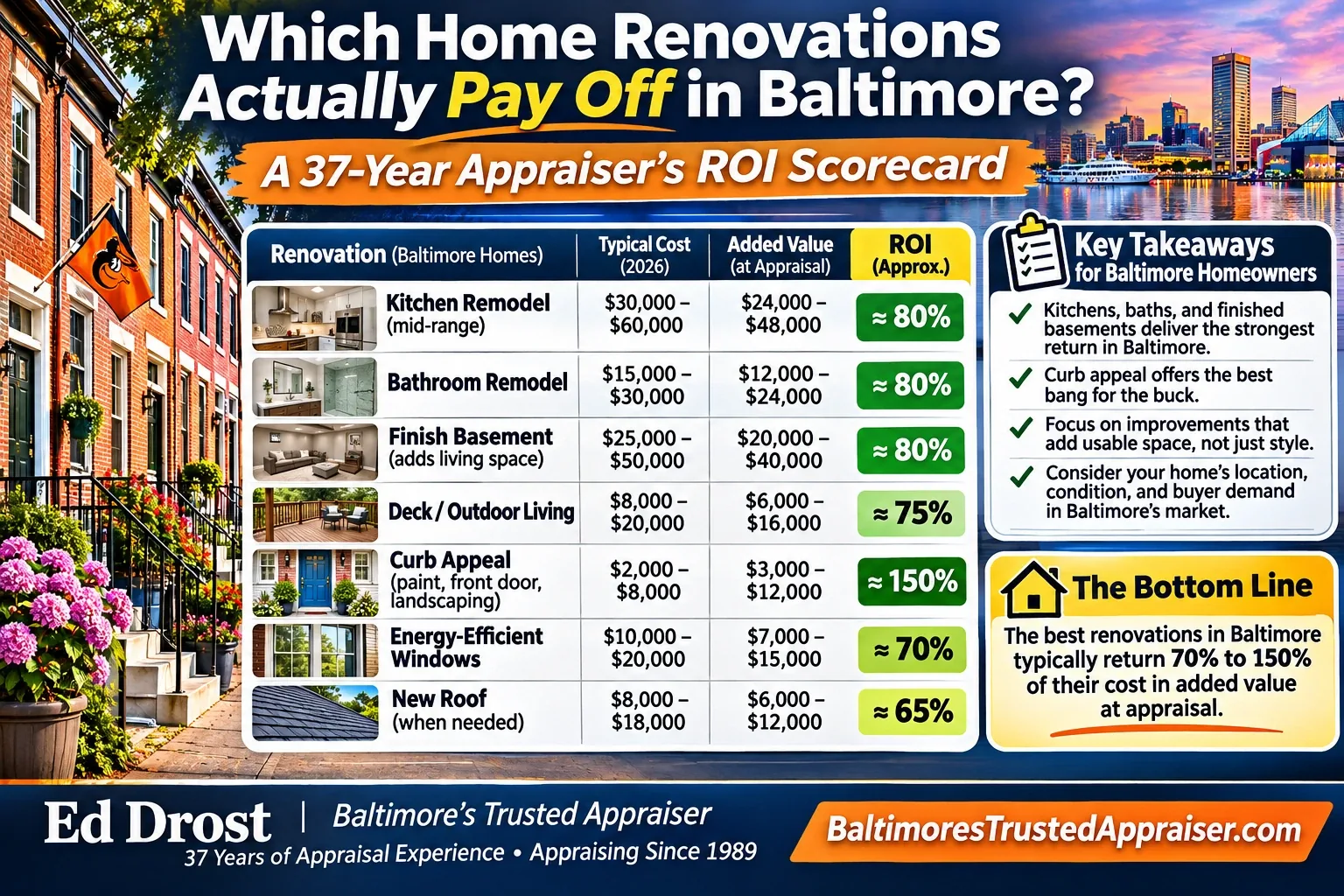
The renovation ROI scorecard
The first four columns are my rule-of-thumb ranges for the Baltimore metro area. They are illustrations of how I think about each project, not quotes. The last column is the national average from the industry's annual Remodeling Cost vs. Value Report (the 2025 edition, the latest I found), so you can see both side by side. National figures come from surveys of real estate professionals, and they run differently from what a specific block's comps will support.
| Project | Typical local cost | Value I'd expect to support | Typical ROI | National benchmark |
|---|---|---|---|---|
| Garage door & entry door replacement | $4,200 – $6,500 | $6,000 – $10,500 | 140% – 200%+ | Garage door 268%; steel entry door 216% |
| Whole-home paint & flooring refresh | $7,000 – $14,000 | $9,000 – $17,000 | 110% – 130% | n/a |
| Minor midrange kitchen refresh (counters, cabinet paint or reface, appliances) | $15,000 – $28,000 | $14,000 – $26,000 | 85% – 95% | 113% (midrange minor kitchen) |
| Half-bath added to a 1-bath rowhouse or Cape Cod | $12,000 – $20,000 | $11,000 – $18,000 | 80% – 90% | n/a (midrange bathroom addition averages 53%) |
| Midrange bathroom remodel | $18,000 – $30,000 | $13,000 – $22,000 | 70% – 75% | n/a |
| Finished basement rec room (7'+ ceiling, central HVAC) | $30,000 – $50,000 | $20,000 – $35,000 | 65% – 70% | n/a |
| Rooftop deck (Canton, Federal Hill, Fells Point) | $22,000 – $38,000 | $14,000 – $24,000 | 60% – 70% | n/a |
| Full-gut luxury kitchen (layout move, custom cabinets) | $65,000 – $110,000+ | $35,000 – $60,000 | 50% – 55% | 51% (major kitchen) |
| Primary suite or second-story addition | $120,000 – $200,000+ | $40,000 – $75,000 | 30% – 40% | About 32% (midrange primary suite) |
| In-ground swimming pool | $65,000 – $100,000 | $15,000 – $30,000 | 25% – 35% | n/a |
A few notes on reading it:
- A finished basement is valued on its own below-grade line of the appraisal grid, at a fraction of the above-grade rate. I explain that in my basement square footage article.
- A full-gut kitchen only pencils out in the $750,000-plus tiers, such as Roland Park, Ruxton, Greenspring Valley and Phoenix.
- A primary suite has high lifestyle value if you are staying ten years or more. It is rarely a profit on resale alone.
- A pool carries heavy maintenance costs, and Maryland's short swim season limits the pool of buyers who will pay for it.
Three Baltimore-area nuances most homeowners miss
A. Rowhouse rooftop decks: expected vs. over-built
In Federal Hill, Locust Point, Canton and Fells Point, a rooftop deck with skyline or water views is a major selling point. Many owners assume a $35,000 multi-tier deck with a wet bar and a pilot house adds $35,000 to the appraisal.
In my experience it does not. Where I find support for a standard rooftop deck, it has generally been in the range of $15,000 to $25,000 when compared with an otherwise identical rowhouse without one, and it always comes down to the closed sales on your blocks. Once you spend $45,000 or more on custom railings and a wet bar, you are paying for your own enjoyment rather than recoverable equity.
B. "Deferred maintenance" is not "upgrade"
Replacing a 22-year-old roof, a failing cast-iron sewer lateral or an outdated 100-amp electrical panel is critical, especially if your buyer is using FHA or VA financing, where peeling paint or an active roof leak can stop a closing cold.
But I treat a working roof, functional HVAC and safe electrical service as the baseline buyers expect. Spending $18,000 on a new roof protects you from an $18,000-plus condition deduction. It does not add $18,000 on top of what renovated comparable homes sold for.
C. The Baltimore CHAP historic tax credit
Baltimore City has one real exception where renovation math flips in the owner's favor: the CHAP (Commission for Historical and Architectural Preservation) historic tax credit.
If you own a qualifying home in a CHAP historic district, such as parts of Bolton Hill, Federal Hill or Fells Point, and your CHAP-approved rehabilitation costs exceed 25% of the property's pre-rehabilitation cash value, the City grants a 10-year credit that offsets the property tax increase caused by the renovation. A few things matter here:
- Get approval first. The work must be approved by CHAP before it begins, and it has to meet the CHAP design guidelines.
- The credit is transferable. It can pass to the next owner for the rest of the 10-year period, and the new owner files an application to continue it.
- It can be appraisable value. When a home has years left on a transferable credit and the comps do not, I analyze the present value of the remaining tax savings and make a market-supported adjustment.
I go into the details in my guides on which neighborhoods qualify and the application steps and common mistakes.
Respect your block's ceiling: progression and regression
Every neighborhood in central Maryland has an invisible price ceiling set by recent closed sales on the surrounding blocks.
- On a $240,000 rowhouse block in Hamilton, Lauraville or Parkville, buyers expect clean, move-in-ready finishes: quartz or solid-surface counters, stainless appliances, updated baths, refinished hardwood. Put $90,000 of imported Italian cabinetry and commercial ranges into that kitchen and you own the nicest house on the block. I cannot pull comps from a $650,000 neighborhood two miles away to justify what you spent.
- In an $850,000 neighborhood like Roland Park, Ruxton or Fallston, the opposite is true. Buyers expect a chef's kitchen, a primary bath and a finished lower level. A 1992 oak kitchen in an $850,000 home draws a steep functional obsolescence adjustment.
Don't put more than 10% to 15% of your home's current market value into a single-room remodel, unless you are fixing a major functional flaw (like a one-bathroom layout) or unlocking a transferable CHAP credit.
A hypothetical: smart refresh vs. full gut
Take a dated 1978 split-level in Perry Hall or Catonsville worth $340,000 as-is, where fully updated homes on the street sell for about $395,000. These numbers are an illustration of how the math works, not a prediction for your house.
- Option A, the over-improved full gut: you spend $75,000 on moved walls, relocated plumbing, custom cabinets and high-end stone. The house appraises right at the neighborhood ceiling of about $398,000. You gained $58,000 in value, a net loss of $17,000 at resale.
- Option B, the targeted refresh: you spend $28,000 total. That is painted solid-wood cabinets, new quartz counters and a tile backsplash ($13,500), a refreshed hall bath vanity and lighting ($6,500), and interior paint plus new LVP in the lower family room ($8,000). The house appraises at about $390,000. You gained $50,000 in value, a net equity gain of $22,000 (about 178% of what you spent), and the house sells faster.
Before you sign a contractor: get an "as-completed" opinion
If you are planning a major renovation, or applying for a home equity line or a renovation loan, find out what your home will really be worth when the dust settles before you spend the money. I provide independent, USPAP-compliant "as-is" and "subject-to-completion" appraisals, using real closed neighborhood comps to show you where your renovation equity ceiling sits.
Common questions
Which home renovations have the highest appraisal ROI in Baltimore?
Targeted cosmetic and curb-appeal projects usually return the most per dollar: garage and entry door replacements, whole-home paint and flooring updates, a midrange kitchen refresh, and adding a half-bath to a one-bath rowhouse. Large structural projects such as a primary suite addition or a full-gut luxury kitchen typically recover only a fraction of their cost at resale.
Does a new roof or HVAC system increase my home's appraised value dollar-for-dollar?
Generally no. Appraisers treat a sound roof, working HVAC system and safe electrical service as baseline expectations. Replacing worn systems protects you from condition deductions and lender repair requirements rather than adding dollar-for-dollar value above comparable homes.
How much value does a rooftop deck add to a Baltimore rowhouse?
It depends on the neighborhood and the comparable sales. In harbor-area rowhouse neighborhoods like Canton, Federal Hill and Fells Point, a standard rooftop deck is often expected by buyers and is typically supported at well under its full construction cost, and custom features beyond the standard are recovered at a lower rate still.
Questions about your own property? Call me and I will point you the right way.
Sources
- Zonda: 38th Annual Cost vs. Value Report, national top ten (press release)
- DASMA: Cost vs. Value Report 2025 summary
- Remodeling Cost vs. Value 2025: national data
- Baltimore City DHCD: Tax incentives, CHAP historic tax credit
- Live Baltimore: Historic Restoration and Rehabilitation Property Tax Credit
- Baltimore City Code, Article 28 §10-18: Property tax credit terms
This article is general information, not legal, tax or financial advice. All dollar examples are hypothetical and rules change, so confirm current requirements with your lender, a Maryland attorney, your CPA or a title company. Local cost and ROI ranges are the author's illustrative rules of thumb; national benchmark figures are from the Remodeling Cost vs. Value Report (2025 edition). Actual contributory value depends on the comparable sales in your market.