
Home › Articles › How Much Is My Baltimore House Worth?
A Baltimore home's market value depends on its location, condition, size, improvements and comparable sales as of a specific date. Zillow gives an automated estimate, Maryland SDAT sets a value for property taxation, and a professional appraisal gives an independent, property-specific opinion of value supported by market evidence. They can differ substantially, and the right one depends on the decision you are making.
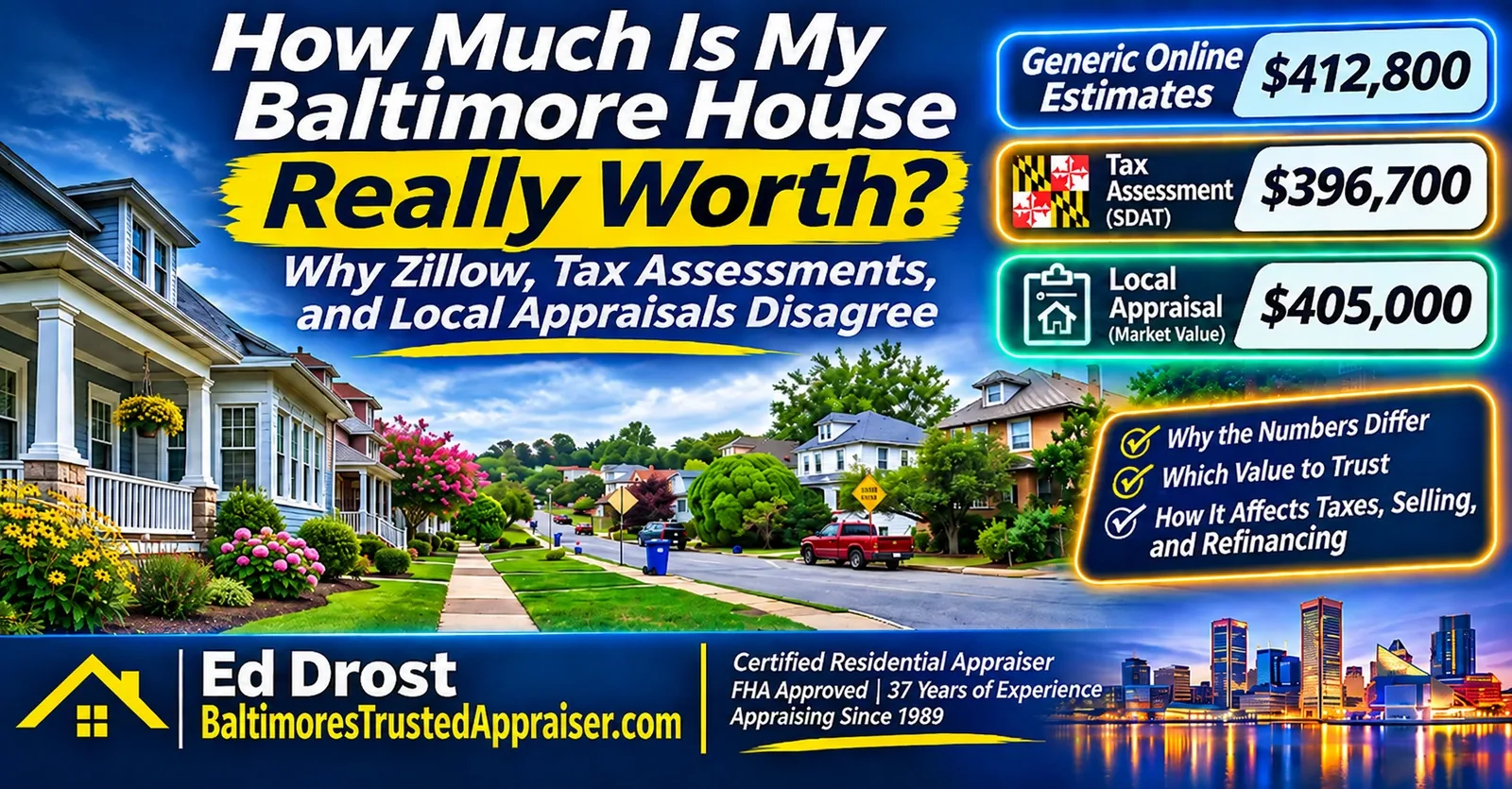
Your Zestimate says $412,800. Maryland's assessment says $396,700. Your real estate agent thinks it could sell for $430,000. Three numbers. One house. Which one should you trust?
It is the question I hear more than any other from Baltimore homeowners.
I have appraised residential real estate throughout Baltimore City, Baltimore County, Carroll County and Harford County since 1989. Here is the most important thing I have learned:
The biggest mistake homeowners make is not trusting the wrong number. It is assuming all three numbers measure the same thing.
They do not. And when you are selling a house, settling an estate, dividing marital property or challenging a tax assessment, that difference can cost real money.
How do the three numbers compare?
| Zillow Zestimate | Maryland SDAT assessment | Independent appraisal | |
|---|---|---|---|
| Built for | Consumer information and engagement | Distributing property tax fairly | A specific financial, legal or lending decision |
| How often it changes | Updated frequently | Reassessed on a 3-year cycle | A snapshot as of one effective date |
| Property inspection | None. It is computer-modeled | Mass appraisal, not property by property | Physical observation by the appraiser |
| Neighborhood detail | Statistical, often broad | Assessment-wide models | Block-by-block market analysis |
| Knows your condition and updates? | Only if the data does | Only as recorded | Yes, documented in the report |
| Best used for | Casual tracking and curiosity | Reviewing your tax bill | Estates, divorce, appeals, sales and other high-stakes decisions |
Let's look at why each one lands where it does.
Is a Zillow Zestimate an appraisal?
No, and Zillow says so itself. I will give Zillow credit: its automated valuation technology has improved considerably. It analyzes public property records, MLS information, prior sales, property characteristics and market trends. For a fairly uniform home in a neighborhood with plenty of recent sales, it can give you a useful ballpark.
According to Zillow's published accuracy information, its nationwide median error rate is roughly 1.8% for homes listed for sale and about 7% for off-market homes. Unless your house is on the market, it is an off-market home.
What does that look like in dollars? Take a Baltimore home that eventually sells for $400,000. A 7% error is $28,000, which could mean an estimate near $372,000 or $428,000.
A median is not a maximum. By definition, about half of all estimates miss by more than the median. These are national figures, not a prediction of what Zillow will get wrong on your particular property.
What can an algorithm not see?
Picture two Canton rowhouses. Both have three bedrooms, two baths and about 1,600 square feet. One has a renovated kitchen, updated mechanical systems, a finished basement and off-street parking. The other has dated finishes, deferred maintenance and no parking.
On paper they look alike. Buyers will not see them that way.
A model can use photos, listings and public records, but its conclusion is only as good as that data. If an improvement was never recorded, the square footage is wrong, or the home's real condition differs from its file, the estimate misses something important. Sales that are not true open-market transactions, such as estate transfers, family sales or distressed sales, can also muddy a neighborhood's numbers if they are not properly sorted out.
Why is Baltimore especially hard for automated values?
Baltimore is not a market where every house fits neatly into a spreadsheet. Values can change across a single street, and buyers think in terms of neighborhoods, blocks and sometimes even alleys.
Canton and Butchers Hill. Both have historic rowhouses, renovated properties and established blocks. But parking, condition, buyer preferences and individual block characteristics can move prices differently. A comparable sale across a neighborhood boundary is not automatically wrong. The real question is whether buyers see the two homes as competing alternatives.
Federal Hill and Riverside. Similar homes may attract overlapping buyers, yet parking, rooftop decks, views, renovation quality and proximity to amenities all affect marketability. An appraiser must find support in the market for an adjustment, not assume every rooftop deck or parking pad is worth the same dollar amount.
Hampden and Woodberry. Older housing stock, renovated mill-area properties and varied architecture mean a home's individual characteristics matter as much as its neighborhood.
Historic districts. If your home sits in a Baltimore City CHAP district, preservation rules and the historic character of the block can be part of the valuation conversation.
Parkton, Monkton and Hereford. Head north into Baltimore County and the problem changes. Now we are weighing acreage, wells and septic systems, outbuildings, easements, rural settings and sometimes very few comparable sales. A three-acre property is not automatically worth a fixed amount more than a one-acre property. The extra land has to contribute value in the eyes of the market.
Baltimore real estate is hyperlocal. A model can recognize a ZIP code. An appraiser has to understand the competitive market inside it.
Why doesn't my SDAT assessment match today's value?
The number on Maryland's property tax records comes from the State Department of Assessments and Taxation, or SDAT. Its purpose is to set a fair basis for property taxes. It is not a prediction of what your house would sell for today.
Under Maryland's system, real property is generally reassessed once every three years, and increases in assessed value are phased in over three years. SDAT uses market evidence and property characteristics, including sales comparison and cost information. That is legitimate valuation work, but it is a different assignment from an independent appraisal of your individual property as of today.
Here is why the numbers may not match:
- The assessment may carry an earlier valuation date.
- The market may have moved since that date.
- SDAT's records may not reflect your home's current condition or recent improvements.
- Characteristics such as square footage or finished areas may be recorded differently than they exist.
- The amount on your notice may reflect phase-in provisions or tax credits.
That last point trips up a lot of homeowners. For owner-occupied principal residences, Maryland's Homestead Tax Credit limits how much your taxable assessment can rise each year. State law sets that cap at 10% or less, and each jurisdiction sets its own. Baltimore County, for example, has recently used 4%. Check the current figure for your jurisdiction.
So before you compare anything to a Zestimate, be sure you know which figure you are looking at: SDAT's market value, the phased-in assessment, or the taxable assessment. They are not the same number. You can review your record through the Maryland SDAT Real Property Data Search.
What does a Baltimore assessment example look like?
Suppose SDAT sets a new market value of $360,000 on a home, and the owner notices similar houses selling between $390,000 and $425,000. Did SDAT make a mistake?
Not necessarily. Ask three questions first:
- Did those sales happen before or after the assessment's valuation date?
- Are those properties genuinely comparable?
- Does the assessment accurately reflect your property's characteristics and condition?
A tax assessment is not a guaranteed measure of what your house would sell for today. And a Zestimate higher than your assessment does not mean your taxes should go up. If you believe your assessment is wrong, read Your Baltimore Property Tax Assessment Went Up. Here's How to Fight It.
What does one house look like with three different values?
Imagine a renovated three-bedroom Baltimore rowhouse with a finished basement, updated kitchen, two full baths and a rear parking pad. Here are three hypothetical values:
| Valuation source | Indicated value |
|---|---|
| Zillow Zestimate | $412,800 |
| Maryland SDAT value | $396,700 |
| Independent appraisal | $405,000 |
Illustrative educational example only. Not an actual property appraisal, verified Zestimate or SDAT record.
The gap between Zillow and SDAT is $16,100, and the appraisal falls in between. That is a fairly tight spread, and in real life the gaps are often wider. It also does not mean the appraisal is "right" because it lands in the middle. Sometimes an appraisal comes in below both figures, or above both. What matters is the evidence behind the number.
Suppose an appraiser analyzes three relevant recent sales:
| Comparable sale | Sale price | Illustrative net adjustment | Adjusted indication |
|---|---|---|---|
| Sale A | $390,000 | +$15,000 | $405,000 |
| Sale B | $415,000 | -$10,000 | $405,000 |
| Sale C | $400,000 | +$5,000 | $405,000 |
All three point to $405,000 once differences are accounted for. In real practice, every adjustment has to be supported by market evidence. Sales are weighed for relevance and reliability, and the appraiser reconciles the indications rather than simply averaging them. This example is tidy on purpose.
That $405,000 is not a guaranteed selling price. It is a reasoned conclusion based on stated assumptions and evidence. That is the distinction homeowners need to understand.
What does a certified Baltimore appraiser actually do?
A professional residential appraisal is much more than glancing at recent neighborhood sales. The process generally includes:
- Property identification and research. Reviewing location, public-record information, site characteristics and property history. In Baltimore, that can include checking whether ground rent is part of the picture.
- Property observation. Inspecting the property when appropriate for the assignment and documenting its condition, improvements and any issues.
- Market analysis. Identifying competing properties, recent sales, current listings and neighborhood trends.
- Comparable sale analysis. Weighing differences in size, condition, quality, location and amenities, with adjustments supported by the market.
- Reconciliation. Weighing the reliability of the evidence to reach an opinion of value as of a specific effective date.
For most Baltimore residential properties, the sales comparison approach is central. The cost or income approach may also matter, depending on the property and the assignment.
The written report documents the analysis, assumptions and conclusion. A certified appraisal is still an opinion, not a guarantee. But it is developed under professional standards and is meant to be understandable and defensible.
Which number should you use?
It depends on the decision.
| If you want to... | The right starting point |
|---|---|
| Keep an eye on the neighborhood | Zillow or Redfin estimate, with a grain of salt |
| Check your property tax bill | Your SDAT assessment notice and property record |
| Price your home for sale | A local agent's market analysis, plus an appraisal if the home is unusual |
| Settle an estate | A date-of-death appraisal |
| Divide property in a divorce | An independent appraisal at the correct effective date |
| Appeal an assessment | Comparable sales and, often, an independent appraisal |
| Remove PMI | Your lender's requirements, which may call for an appraisal |
When can the wrong value cost you?
Knowing your home's approximate value is one thing. Making a financial decision using an unsupported number is another. Here are five situations where it matters.
Selling your Baltimore home
Price too high and you may discourage buyers and sit on the market. Price too low and you may accept less than the market would have paid. A pre-listing appraisal can help when a home is unusual, recently renovated or hard to compare. I cover this in Should You Get an Independent Home Appraisal Before Selling?
Settling an estate
An inherited property often has to be valued as of the owner's date of death, not today. That value can establish the property's tax basis for the heirs, so it matters. A current Zestimate cannot substitute for a properly developed retrospective valuation. Read What Is a Date of Death Appraisal in Maryland?
Dividing property in a divorce
When one spouse wants to keep the marital home, a supported, unbiased value helps inform the financial negotiation. The right effective date and valuation assumptions depend on the circumstances and the legal instructions in the case. See How Do Home Appraisals Work in a Maryland Divorce?
Challenging a Maryland tax assessment
If you believe SDAT overvalued your property, the clock matters. Maryland generally gives you 45 days from the date on your assessment notice to file an appeal. Start by reviewing the valuation date, the property record and the comparable sales. A properly scoped independent appraisal can be useful evidence, although no appraisal guarantees a successful appeal. Review Maryland's assessment appeal procedures before you file.
Considering a cash offer
A quick cash offer can offer convenience, certainty and lower preparation costs. But convenience and market value are two different things. Before accepting a steep discount, understand what the property might bring with normal market exposure. See Should You Accept a "We Buy Houses" Cash Offer?
Can you get a sense of value without paying for an appraisal?
Sometimes, yes. Here is where I would start:
- Check your SDAT record for incorrect square footage, bedroom or bath counts, or other factual errors.
- Look at closed sales, not just active listing prices, of genuinely comparable homes.
- Ask an experienced local agent for a comparative market analysis if you are thinking of selling.
- Compare any online estimate with its published range, and make sure the property data behind it is accurate.
These steps can give you a useful preliminary picture. But when the dollars are significant, the property is unusual, or you need a documented independent opinion, a professional appraisal is worth considering. My Baltimore Home Appraisal Cost Guide explains typical fees. Not every homeowner needs an appraisal. The key is knowing when a rough estimate is enough, and when it is not.
What should you do before an appraisal?
- ☐ Pull your SDAT record. Confirm the square footage, bedroom and bath counts and finished areas are right, and note the date of your latest assessment notice.
- ☐ Note your notice date. If you plan to appeal, the 45-day window starts on the date printed on the notice.
- ☐ Document your improvements. Keep a dated list of major upgrades such as the roof, HVAC, kitchen, baths and finished basement, with costs if you have them.
- ☐ Gather your paperwork. Surveys, permits and any ground rent information help the appraiser start with accurate facts.
- ☐ Know your purpose. Estate, divorce, appeal, sale or lender request? The purpose determines the type of appraisal and the effective date.
Common questions
Is Zillow accurate for Baltimore homes?
Zillow can be a useful starting point, particularly when the property data is accurate and recent comparable sales are plentiful. Accuracy varies by property and location, and a Zestimate is not a substitute for a professional appraisal.
Why is my Zillow estimate higher than my Maryland tax assessment?
The two figures can use different data, valuation dates and methods. In addition, your taxable assessment can differ from SDAT's market value because of phase-in provisions and tax credits.
Can my Baltimore home be worth more than its tax assessment?
Yes. The market may have changed since SDAT's valuation date. However, a higher sale price or Zestimate alone does not prove an assessment was wrong.
Does a finished basement increase appraisal value?
It can. The amount depends on its condition, utility, market acceptance and comparable sales. Finished below-grade space is generally analyzed separately from above-grade living area rather than valued at the same rate.
Will an appraisal tell me exactly what my home will sell for?
No. An appraisal is a supported opinion of value as of a specific date. Actual sale prices also depend on marketing, buyer motivation, negotiation, financing and transaction conditions.
Should I get an appraisal before listing my house?
Consider one if your property is unique, recently renovated or hard to compare, or if you want an independent perspective. For a typical home with strong comparable sales, a qualified agent's market analysis may be enough to set the initial price.
The bottom line
After 37 years of appraising Baltimore-area homes, I have watched neighborhoods transform, seen renovated rowhouses breathe new life into older blocks, and worked on northern Baltimore County properties whose value simply cannot be found in a countywide average. Technology has made property information easier to find, and that is a good thing. But access to information and an accurate interpretation of it are not the same thing.
Zillow gives you an automated estimate. Maryland SDAT gives you a valuation for property taxation. A professional appraisal gives you a documented, independent opinion of value for a defined purpose. Each has its place.
So the real question is not, "What number is on my screen?" It is this: "What is my property worth for the decision I need to make, and what market evidence supports that value?"
Sources
- Zillow: Zestimate accuracy and "not an appraisal" disclosure
- Maryland SDAT Real Property Data Search
- Maryland SDAT: Homestead Tax Credit
- Maryland SDAT: assessment appeal process
This article is general information, not legal, tax or financial advice. All dollar examples are hypothetical and rules change, so confirm current requirements with your lender, a Maryland attorney, your CPA or a title company.