
Home › Articles › Appraisal Gap and Appraisal Waiver Explained
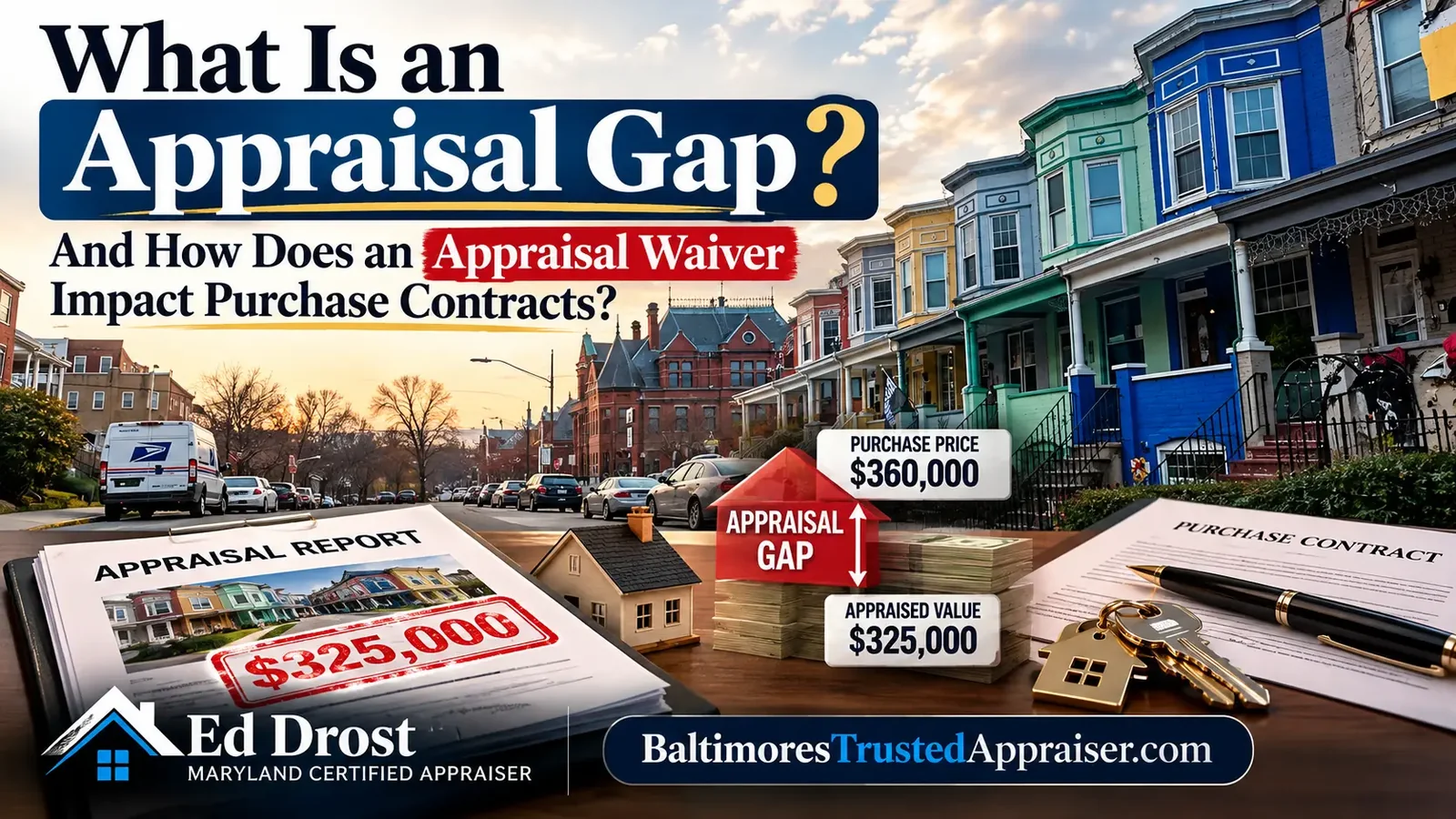
An appraisal gap occurs when the appraised value comes in below the contract price. Because lenders base the loan on the lower of the price or the appraised value, buyers must cover the difference in cash, renegotiate the price, or cancel if the contract allows. A gap clause is a promise to pay some or all of that shortfall.
I am Ed Drost, a Maryland State Certified Residential Appraiser and FHA appraiser. I have appraised homes across Baltimore City and Baltimore, Carroll and Harford counties since 1989, and I answer these questions every week for buyers, sellers and families. This article is part of our Baltimore appraisal Q&A series.
What is an appraisal gap?
The appraisal gap is the difference between the contract price and a lower appraised value. A lender will lend a percentage of the lower of the two numbers. If a home under contract for $400,000 appraises for $385,000, the gap is $15,000, and the lender's loan is based on $385,000.
What does a gap actually cost?
Many buyers think they must pay the full gap on top of everything else. The real cost is the gap times the loan-to-value ratio, because the lender still funds its percentage of the lower value. Here is an example with a 20% down payment:
| Appraises at price | Appraises $15,000 low | |
|---|---|---|
| Contract price | $400,000 | $400,000 |
| Appraised value | $400,000 | $385,000 |
| Maximum loan (80%) | $320,000 | $308,000 |
| Cash the buyer needs (price minus loan) | $80,000 | $92,000 |
In this example the buyer needs $12,000 more cash, not $15,000, because the lender still lends 80% of the lower value. At a lower down payment the extra cash is closer to the full gap. A rough rule is: extra cash equals the gap multiplied by the loan-to-value ratio.
What is a gap clause?
An appraisal gap clause (or gap coverage) is an agreement, often added to the purchase contract, that the buyer will pay some or all of any shortfall in cash, usually up to a stated limit, so the sale can go ahead. For example: "Buyer will pay up to $15,000 above the appraised value." It makes an offer more attractive to a seller, but it is a real financial promise, so only sign one if you have the cash.
What are the two kinds of appraisal waivers?
The term "appraisal waiver" is used for two very different things, so check which one is meant:
- An appraisal contingency waiver (buyer's choice). The buyer gives up the contract right to cancel or renegotiate if the appraisal is low. The lender still requires an appraisal, so the buyer must make up the gap or lose the deposit if they cannot close. This is the risky one.
- A lender appraisal waiver (also called value acceptance). For some loans, the loan-underwriting system may accept the price or a data-based value and skip the appraisal altogether. That happens only when the lender and loan type allow it, and it does not guarantee that the home is worth the price.
Keep them separate: a buyer can waive the contingency and still face a required appraisal, and a lender can skip the appraisal while the contract still has a contingency.
What can buyers and sellers do?
- Request a reconsideration of value if the report has errors. See how the ROV process works.
- Renegotiate. Sellers often meet in the middle, rather than lose the deal.
- Bridge the gap in cash, if it fits your budget and your gap clause.
- Cancel, if your contract's appraisal and financing terms allow it. Deadlines are strict, so ask your agent or attorney early.
- Sellers can prepare. A pre-listing appraisal or a clean, well-documented home with a list of improvements helps the appraiser see the full picture.
The appraiser cannot be told a target value or pressured to hit the price. Appraisal independence rules prohibit it, and a report built to reach a number is not worth the paper.
How does this play out in Baltimore?
I have appraised homes across Baltimore City and Baltimore, Carroll and Harford counties since 1989. Gaps tend to appear where prices rise faster than closed sales, in neighborhoods with few good comparables, and with unique homes such as historic rowhouses or properties with ground rent. In those cases an appraiser can only use sales that have actually closed, so a hot street may appraise below a bidding-war contract price. If you are listing and want to know where you stand, a pre-listing appraisal can show it before you sign a contract.
Common questions
What is an appraisal gap?
An appraisal gap is the difference between the contract price and a lower appraised value. The lender bases the loan on the lower number, so the buyer must cover the shortfall in cash, renegotiate, or cancel.
How much extra cash does an appraisal gap require?
Roughly the gap multiplied by the loan-to-value ratio. With an 80% loan and a $15,000 gap, the buyer needs about $12,000 more cash, because the lender still funds 80% of the lower value.
What is an appraisal gap clause?
It is a contract term in which the buyer agrees to pay some or all of any shortfall in cash, often up to a stated limit, so the sale can proceed.
What does it mean to waive the appraisal?
It can mean the buyer waives the appraisal contingency and gives up the right to cancel over a low value, or the lender waives the appraisal for a loan that qualifies. They are different, so confirm which one applies.
Can a low appraisal be challenged?
Yes, through a reconsideration of value submitted via the lender with factual errors or better comparable sales. It is not guaranteed to change the value.
Sources
This article is general information, not legal, tax or financial advice. Rules and lender procedures change and every transaction is different. Confirm current requirements with your lender, a Maryland attorney or a title company.
More articles
What Is a Reconsideration of Value (ROV) and How Do You Overturn a Low Appraisal?
How to challenge a low home appraisal: what evidence works, what does not, and your options if the value stays the same.
Who Legally Owns the Appraisal Report: The Homebuyer or the Mortgage Lender?
Who owns the appraisal you paid for? The lender is the client, and you have a legal right to a copy. What that means in practice.

The 7 Property Maintenance Red Flags That Delay FHA and Conventional Appraisals
The seven safety and condition problems that stall FHA and conventional appraisals, and the typical fix for each.