
Home › Articles › What Is a Reconsideration of Value (ROV)?
A Reconsideration of Value (ROV) is a formal request, made through the lender, asking for a review of a home appraisal. To succeed, borrowers need facts rather than opinions: uncredited square footage or features, or a few closed comparable sales in the same neighborhood that sold before the appraisal's effective date.
I am Ed Drost, a Maryland State Certified Residential Appraiser and FHA appraiser. I have appraised homes across Baltimore City and Baltimore, Carroll and Harford counties since 1989, and I answer these questions every week for buyers, sellers and families. This article is part of our Baltimore appraisal Q&A series.
What is a reconsideration of value?
A Reconsideration of Value, or ROV, is a written request asking the lender to have the appraiser take another look at an appraisal. It is not a complaint about the appraiser, and it is not a second appraisal. It is a request to correct a factual mistake or to consider information the appraiser did not have or did not use.
Federal banking regulators have issued guidance expecting lenders to have a process for these requests, so most lenders will accept one, but the exact steps and forms differ from lender to lender. Ask your loan officer how theirs works.
How does the ROV process work?
- You tell your loan officer. Borrowers and agents generally cannot contact the appraiser directly. The lender is the appraiser's client, and the rules are designed to keep the appraiser independent.
- You send evidence to the lender in writing, using their form or process.
- The lender passes it to the appraiser (or to a reviewer), who considers it.
- The appraiser may revise the report or explain why the value stands. The appraiser decides the value, based on the evidence and their professional judgment.
What evidence actually works?
| Strong evidence | Weak evidence |
|---|---|
| Wrong square footage, bedroom or bathroom count, shown by plans, permits or measurements | "The online estimate is higher" |
| Renovations or features left out, such as a finished basement, new roof or added bath, with dates, permits and photos | "We paid more than that for the house" |
| Three to five closed sales, in the same micro-neighborhood and of similar style, size and condition, that closed on or before the appraisal's effective date | Asking prices, pending sales or listings |
| A comparable that was used but does not fit: different style, across a boundary, or a distressed sale | "My neighbor's house sold for more" |
The contract price is not evidence of value. Appraisers consider it, but they must support the value with comparable sales.
What is the step-by-step process?
- Get the full report from your lender. You are entitled to a copy.
- Read it for facts. Check living area, room counts, lot, year built, condition notes and each comparable's details.
- List every error with proof: a measurement, a permit, a photo.
- Find better comparables if you believe the ones used are weak. Pick closed sales close by, similar in style and size, and sold before the effective date.
- Write a short, factual request to the lender listing each item and what you are asking them to reconsider. Leave out emotion and the contract price.
- Ask for the result in writing and keep your closing deadlines in mind.
What do ROVs look like in Baltimore?
I have appraised homes across Baltimore City and Baltimore, Carroll and Harford counties since 1989. A few local situations come up often:
- Rowhouses: end-of-group units, renovated interiors and finished basements are priced differently from interior units with original systems.
- Neighborhood boundaries: two blocks apart can be two different markets, and a comparable across the City/County line may not fit.
- Ground rent: a ground rent on the subject or on a comparable can change the comparison. See how ground rent affects appraisals.
- Unpermitted or unfinished space: appraisers may count only what meets measuring standards, so a "finished" basement can be credited in part.
What if the value does not change?
A good ROV can move the number, but it is never guaranteed. If the value stands, buyers generally have these choices:
- Renegotiate the price with the seller.
- Cover the difference in cash. Read our guide to the appraisal gap first.
- Change the loan, for example a larger down payment.
- Ask the lender about another appraisal. Many lenders will not allow shopping for a higher number, and the result may not replace the first, so ask before paying for anything.
- Walk away, if your contract's financing or appraisal terms allow it.
Common questions
What is a reconsideration of value?
A reconsideration of value, or ROV, is a written request made through the lender asking the appraiser to review an appraisal, usually because of a factual error or additional comparable sales.
How do I challenge a low home appraisal?
Ask your loan officer for the ROV process, get the full report, document any factual errors, and submit a short written request with proof such as measurements, permits, photos, and three to five closed comparable sales.
Can I contact the appraiser directly about a low appraisal?
Generally no. The lender is the appraiser's client, and the request goes through the lender to protect the appraiser's independence.
Will an ROV raise the value?
It can, if you provide facts the appraiser did not have or errors in the report. If the evidence is weak, the appraiser may keep the same value.
What if the ROV fails?
You can renegotiate the price, bring more cash, change the loan, ask the lender about another appraisal, or cancel if your contract allows.
Sources
This article is general information, not legal, tax or financial advice. Rules and lender procedures change and every transaction is different. Confirm current requirements with your lender, a Maryland attorney or a title company.
More articles

Who Legally Owns the Appraisal Report: The Homebuyer or the Mortgage Lender?
Who owns the appraisal you paid for? The lender is the client, and you have a legal right to a copy. What that means in practice.
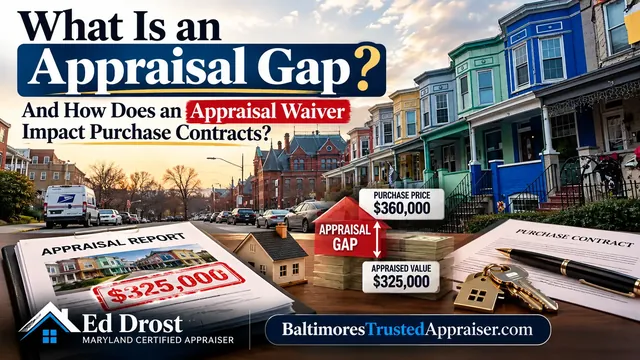
What Is an Appraisal Gap and How Does an Appraisal Waiver Impact Purchase Contracts?
What happens when the appraisal is below the price? A worked example of the gap, gap clauses, and the two kinds of appraisal waivers.

The 7 Property Maintenance Red Flags That Delay FHA and Conventional Appraisals
The seven safety and condition problems that stall FHA and conventional appraisals, and the typical fix for each.