
Home › Articles › What Adds Value in 2027
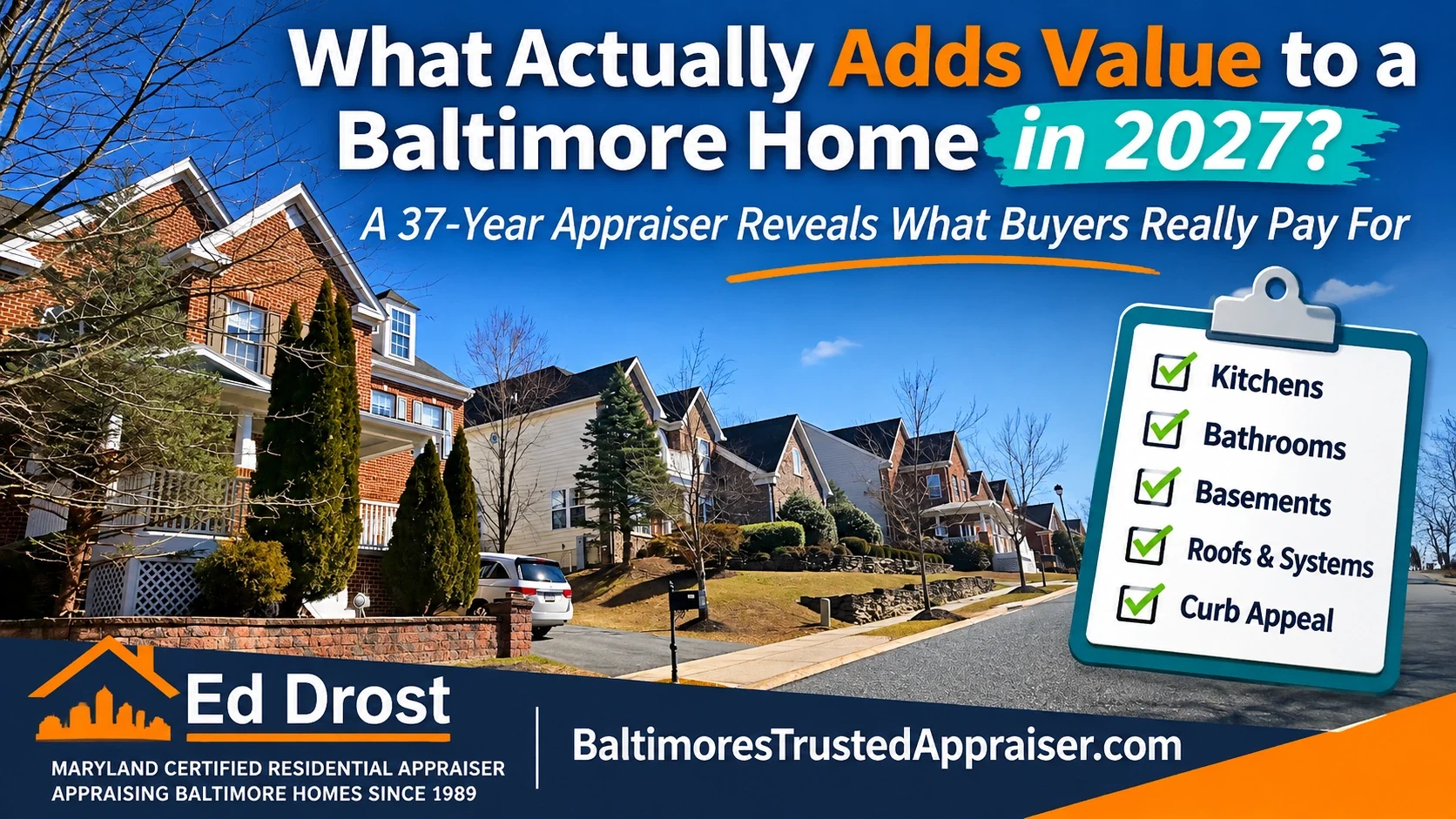
The upgrades most likely to add value are the ones that fix real deficiencies, improve how the house works, and match what buyers expect in your neighborhood and price range. Kitchen and bath updates, necessary roof or system repairs, exterior maintenance and usable living space can all help. But the amount you spend does not automatically equal the value you add.
I judge improvements by local market evidence, meaning comparable sales. I don't go by contractor invoices or national ROI charts. That distinction can save you thousands of dollars.
The $50,000 Renovation That Doesn't Add $50,000
I've been appraising homes in Baltimore City and Baltimore County since 1989, and one misunderstanding comes up more than any other. Homeowners figure that if they put money into a house, the value goes up by about the same amount. Real estate doesn't always work that way.
Here's a hypothetical. A Baltimore County homeowner spends $50,000 on a kitchen: custom cabinets, stone counters, premium appliances, new flooring. It looks beautiful. But when I compare the house to similar homes in the neighborhood, the sales show buyers paying only about $25,000 more for updated kitchens. The owner put in $50,000 and may have created $25,000 in market value.
That doesn't mean the kitchen was a mistake. If the owner enjoys it for ten years, the personal value may justify the cost. But if they're selling in six months, the math looks very different.
The most important rule of renovation economics is this: cost is not value.
What the Baltimore Market Looks Like Heading Into 2027
Here is Bright MLS's October 2026 report for the Baltimore metro:
| Market indicator | October 2026 |
|---|---|
| Median sold price | $405,000 |
| Closed home sales | 2,203 |
| Year-over-year closed sales | -15.7% |
| Median days on market | 19 |
| Active listings | 8,181 |
| Months of supply | 3.29 |
Source: Bright MLS, October 2026 Baltimore Metro Housing Market Report.
The metro median sold price was unchanged from October 2025, and inventory is up. That doesn't mean prices are falling everywhere. It does mean you should be careful about assuming buyers will pay a premium for every improvement.
A renovated home in Canton competes in a different market than a detached house in Towson or a rowhouse in Belair-Edison. Even inside one ZIP code, property type, condition, parking, location and competing sales change the answer. The right renovation in one Baltimore neighborhood can be a poor financial decision in another.
1. Kitchens: Update for Your Market, Not Your Dream Kitchen
Buyers notice the kitchen first. A dated or poorly kept kitchen hurts marketability, especially when competing homes have been updated. But there's a big difference between modernizing a working kitchen and installing a luxury one that goes past what your neighborhood expects.
Improvements that can add value:
-
Replacing worn or damaged countertops.
-
Refinishing or replacing dated cabinets.
-
Fixing lighting and electrical problems.
-
Installing functional, reasonably priced appliances.
-
Replacing badly worn flooring.
-
Fixing a poor layout.
A modest update often makes more financial sense than a complete rebuild. The 2025 Cost vs. Value Report from the Journal of Light Construction estimated that a midrange minor kitchen remodel recovered about 113% of its cost at resale nationally, and that major upscale kitchen remodels recovered a lower percentage. That's a modeled national average. It isn't a guaranteed return or a Baltimore appraisal adjustment. Buyers expect a working kitchen, and once they get it, extra luxury adds less than it costs.
Picture two similar Canton rowhouses. One has a clean, updated kitchen with practical cabinets, modern counters and reliable appliances. The other has a designer kitchen with imported materials and pro-grade appliances. The second one gets attention, but buyers may not pay enough more to cover the extra cost. I'd look at how buyers actually reacted to comparable houses, not assign a dollar-for-dollar adjustment from renovation receipts.
What I'd do: If you're selling soon, a functional, attractive kitchen that fits your market is a more defensible investment than an extravagant one.
2. Bathrooms: Condition and Function Beat Luxury
Bathrooms shape a buyer's impression of the whole house. But again, more expensive doesn't mean more valuable. Compare two projects:
Project A: replace a damaged vanity, fix a leaking fixture, update the lighting, restore worn surfaces and improve ventilation.
Project B: rebuild a working bathroom with luxury tile, custom glass and premium fixtures.
Both improve the house. But Project A fixes things that would otherwise draw buyer objections and repair demands. Project B mostly reflects one person's taste. That matters most in older Baltimore housing, where water damage, aging plumbing, poor ventilation and old wiring count for more than finishes.
Adding a bathroom can contribute real value when it fixes a functional problem, like going from one bathroom to two in a house competing with two-bath homes. But the amount depends on the home's size, location, layout, market expectations, construction quality and the comparable sales available. An added bathroom isn't worth a fixed number.
What I'd do: Fix function first. Buyers usually value a house that works over one with expensive finishes it didn't need.
3. Roofs, HVAC and Major Systems: Protecting Value Is Not Creating Value
Replacing a failing roof may keep the house from losing value without adding the full cost of the roof. Take two comparable homes with working roofs and normal remaining life. One roof is new, the other is older but fine. Buyers may prefer the new one, but that doesn't mean they'll pay the full replacement cost as a premium.
Now take a third house with an active leak and interior water damage. That condition creates buyer resistance, financing problems and repair demands. Fixing it can improve marketability and protect value a great deal.
The same thinking applies to HVAC, electrical service, plumbing, structural repairs, foundation problems, water intrusion and drainage, and windows and exterior upkeep. The 2025 National Association of REALTORS Remodeling Impact Report lists roofing among the projects agents often recommend when it's needed to prepare a home for sale. But a necessary repair and a profit-making investment are not the same thing.
What I'd do: Look at essential systems as protecting your market position, not earning a dollar-for-dollar return.
4. Finished Basements: Useful Space, but Not Above-Grade Living Area
This one matters in Baltimore. Plenty of rowhouses and detached homes have basements that owners turn into rec rooms, offices, bedrooms or guest space. A well-designed finished basement can add usefulness and appeal. But you should know how I classify it.
Under the applicable measurement standards, finished below-grade areas are generally reported separately from above-grade finished living area. For appraisals subject to the Fannie Mae ANSI measurement requirement, a level with any part below grade is treated as below grade, subject to the standard's rules and exceptions. That doesn't mean a finished basement has no value. It means I analyze and report it differently.
Take a rowhouse with 1,600 square feet above grade and 600 square feet of finished basement with a family room and half bath. The owner may call it 2,200 square feet. I'd report 1,600 above grade and 600 finished below grade. The basement can still add value based on market evidence, but you can't multiply those 600 feet by the above-grade rate. A low, dark, damp basement contributes less than a dry, well-finished one with good access.
What I'd do: Before you spend $40,000 finishing a basement, find out how comparable homes with similar basements actually sold. I explain the details in Finished Basement or Unfinished Cellar? How Baltimore Appraisers Count Below-Grade Square Footage.
5. Curb Appeal: First Impressions Affect Marketability
Not every value-related project is a big construction job. The best ones can be simple:
-
Repair worn steps or railings.
-
Repaint tired exterior surfaces.
-
Fix drainage and landscaping.
-
Replace damaged exterior doors.
-
Clean and maintain walkways.
-
Take care of visible deferred maintenance.
In Baltimore, the exterior matters because so many neighborhoods have closely spaced homes with similar architecture. A well-kept rowhouse on a block of comparable properties looks better than one that shows neglect.
Cost vs. Value research has repeatedly ranked smaller exterior projects, like garage and entry door replacement, among the stronger modeled cost recoveries. But those are standardized projects with regional or national estimates. They don't prove that a new door on your Baltimore rowhouse will return the same percentage.
What I'd do: Curb appeal helps marketability, but don't assume expensive landscaping or decorative features create equal market value.
6. Parking, Garages and Outdoor Features: Location Decides
Parking is one of Baltimore's most distinctive valuation issues. In dense neighborhoods like Canton, Federal Hill, Fells Point and Locust Point, off-street parking can influence a buyer's decision. In neighborhoods where most homes already have driveways or garages, parking adds a smaller premium. Either way, the value of a parking pad, garage or legal space has to be supported by local comparable sales.
Before you build a parking pad, check:
-
Whether the space is legally permitted.
-
Zoning and access requirements.
-
Construction and drainage costs.
-
Whether you need curb-cut approval.
-
How similar properties with and without parking have sold.
A space you can't legally or practically use won't give you the benefit you expected.
In Towson, Parkville, Pikesville, Cockeysville and nearby communities, buyers may care about garages, driveway capacity, patios, decks and usable yards, but the contribution varies by property type and neighborhood expectations. A big, expensive outdoor entertainment area can give you plenty of enjoyment without delivering the same resale premium.
What I'd do: Don't assume an improvement's value because it's desirable. Find out whether buyers in your market will pay more for it.
7. Additions and Extra Bedrooms: More Space Isn't Always More Value
Adding square footage can raise value. But additions are where I most want homeowners to compare construction cost with the likely market contribution. Say an owner spends $125,000 on a new family room and bedroom. If the neighborhood's competing homes sell in a narrow price range, the added space may not support a $125,000 increase. The result depends on the home's existing size, design, condition, location and how many larger homes are available.
An addition can hurt appeal if it creates:
-
An awkward floor plan.
-
A bedroom you reach only through another bedroom.
-
Inconsistent ceiling heights.
-
Poor integration with the original house.
-
Inadequate heating or cooling.
-
Unpermitted construction.
-
A house much bigger than typical homes nearby.
A well-designed addition that fixes a real deficiency can be valuable. An expensive one that makes the layout worse is a poor investment.
What I'd do: Before you add space, find out whether the market pays a premium for larger homes of the design you're planning.
Baltimore Renovation ROI Scorecard: What Should You Prioritize?
This is a practical decision guide, not a statistical ranking of Baltimore-specific returns.
| Improvement | Potential benefit | Main concern |
|---|---|---|
| Minor kitchen refresh | Improves appearance and function | Spending beyond local buyer expectations |
| Bathroom repairs and updates | Reduces condition objections | Luxury finishes may not recover cost |
| Roof or HVAC replacement | Preserves condition and marketability | Cost may exceed incremental value |
| Exterior repairs and painting | Improves presentation | Cosmetic value varies by condition |
| Finished basement | Adds usable below-grade space | May contribute less than above-grade space |
| Legal off-street parking | Can be attractive in parking-constrained areas | Permits, costs and neighborhood demand |
| Bedroom or family room addition | Adds functionality and living area | High construction costs and over-improvement |
| Solar installation | May reduce operating costs | Ownership, lease terms and local sales evidence |
| Luxury outdoor upgrades | Increases personal enjoyment | Limited buyer pool for custom features |
The best project isn't necessarily the one with the highest national ROI. It's the one that makes financial sense for your property.
How I Determine What a Renovation Is Worth
I don't add the cost of the renovation to the old value. I look at how the market reacted to the improvement.
Step 1: Identify comparable properties. I look for similar location, size, design, condition and utility.
Step 2: Compare different improvement levels. When reliable evidence exists, I compare homes with and without a particular feature.
Step 3: Consider competing factors. A new kitchen doesn't exist in isolation. Bedrooms, bathrooms, site size, parking, condition and location also affect sale prices.
Step 4: Estimate supported contributory value. How much does the improvement add to overall value? Sometimes it's close to the cost. Sometimes it's far less. In certain markets, it can exceed cost.
Step 5: Reconcile the evidence. A credible appraisal weighs the quality and relevance of the data instead of assuming a universal dollar adjustment.
That's why an appraisal of your house can reach a different conclusion than a national renovation calculator.
A $60,000 Renovation: Does the Math Work?
Here's a hypothetical for a Baltimore County homeowner planning to renovate before selling.
Current estimated as-is value: $350,000
| Project | Estimated cost |
|---|---|
| Kitchen updates | $25,000 |
| Bathroom improvements | $12,000 |
| Flooring and painting | $8,000 |
| Roof repairs and exterior work | $10,000 |
| Landscaping and miscellaneous work | $5,000 |
| Total cost | $60,000 |
Suppose reliable comparable sales, analyzed together, support an after-renovation market value of $390,000. That's a $40,000 increase on a $60,000 spend, a $20,000 shortfall before financing costs, construction delays, surprise repairs and selling costs.
The $390,000 figure is assumed for this illustration. It isn't a real appraisal or a documented Baltimore comparable-sales analysis.
Would it still make sense? Possibly, if you plan to stay and enjoy the work. But if you're selling right away, compare your expected net proceeds from selling as-is with what you'd net after renovating first. Before you invest $60,000, find out whether your local market can support it.
The Over-Improvement Trap
Yes, a house can become too expensive for its neighborhood. This is one of the most important ideas for homeowners to understand.
Say an owner has a modest detached home on a street where comparable homes sell in a certain range. The owner installs a designer kitchen, imported stone, high-end custom finishes and a luxury outdoor entertainment area. The house now costs a lot more to reproduce than its neighbors. But buyers can find larger lots, better layouts or more desirable features nearby for similar money, and that competition limits what they'll pay.
The owner built the nicest house on the block without making the most efficient investment. I look at the home's competitive market, not just how impressive the renovation is.
What Adds Value in Different Baltimore Neighborhoods?
Baltimore is not one uniform market. Neighborhood demand drives everything.
Canton, Federal Hill and Locust Point: working kitchens, parking, outdoor space, finished basements, bathroom count and the quality of earlier renovations. Even desirable improvements need comparable sales behind them.
Hampden, Charles Village and Roland Park: historic character, architectural details, condition, site characteristics and appropriate modernization. Stripping out original features without thinking about the character of the house can reduce what makes it distinctive.
Hamilton, Lauraville and Parkville: functional floor plans, maintenance, usable yards, parking, garages and updated major systems. A house that has dealt with deferred maintenance competes better against well-kept alternatives.
Towson, Lutherville and Timonium: buyers compare kitchen and bath condition, bedroom count, garage capacity, finished space and overall function. The effect of an improvement varies a lot by price bracket and housing type.
Parkton, Monkton and Hereford: larger sites and distinctive properties need attention to site utility, home size, design, condition, outbuildings and the availability of comparables. A major custom improvement may have little comparable-sale support, and rural or semi-rural homes can be especially complex.
Baltimore's older rowhouse neighborhoods: structural condition, mechanical systems, water intrusion, basement usability, renovation quality and the immediate competitive market. A big renovation can improve marketability, but weigh its cost against achievable prices and buyer demand.
In every neighborhood, your property's characteristics and current comparable sales matter more than broad assumptions.
Should You Renovate Before Selling in 2027?
Before you approve a major project, ask yourself these five questions.
1. What is the property worth today?
Start with a credible estimate of current as-is market value.
2. What improvements are truly necessary?
Separate safety, function and maintenance from purely cosmetic preferences.
3. What do buyers expect in my price range?
A renovation that suits a $750,000 home may not make sense for a $225,000 home.
4. What are comparable renovated homes selling for?
Use recent, relevant market evidence, not assumptions.
5. Will the likely added value justify the full cost?
Count contractor charges, permits, contingencies, carrying costs and the chance of delays.
If you plan to sell soon, it may be smarter to make targeted repairs and sell in present condition than to complete a big renovation. There's no universal answer, which is why knowing what your specific property is worth matters.
Frequently Asked Questions About Baltimore Home Improvements and Appraisal Value
What renovations increase appraisal value the most?
Renovations that fix significant condition or functional problems and match buyer expectations can add real value. Kitchen and bath improvements, essential repairs, functional living space and certain exterior upgrades may help. The amount depends on comparable sales and local demand.
Does a new kitchen increase a Baltimore home's value?
It can, especially when the existing kitchen is in poor shape or worse than competing homes. But the contribution isn't necessarily equal to the cost. An expensive kitchen can return a lower percentage than a modest, well-done update.
Does a finished basement count as square footage in a Maryland appraisal?
Finished below-grade areas can add value, but they're generally reported separately from above-grade finished area under the applicable measurement requirements. The classification depends on the property's configuration, the standard and the assignment.
Does a new roof increase appraisal value?
It can improve marketability and ease concerns about condition. But replacing a roof that was working fine doesn't necessarily add the full installation cost. Fixing a failing roof can prevent a loss in marketability or value.
Does adding a bathroom increase home value?
It can, especially when it improves function compared with competing properties. The amount depends on the existing layout, location, property type and competing sales.
Do solar panels increase appraisal value in Maryland?
Owned systems may add value when market evidence supports it. Leased systems and power-purchase agreements need different treatment. Energy savings don't automatically translate dollar-for-dollar into property value.
Is it worth finishing a basement before selling?
That depends on construction cost, moisture, ceiling height, legality, function and comparable sales. Finishing a basement can improve appeal, but the resale value may be less than the cost.
Do appraisers consider renovation receipts?
Receipts, permits and descriptions help me understand what work was done and when. But invoices don't establish contributory value. I evaluate the property's condition, utility and market evidence.
Can I get an appraisal before deciding whether to renovate?
Yes. A current as-is appraisal sets a baseline. Depending on the intended use and scope of work, I can also develop a separate prospective or hypothetical as-completed value based on specified plans and assumptions.
Should I get an appraisal before listing my Baltimore home?
It can help when a property is unusual, heavily renovated, inherited, hard to compare with nearby sales, or when you want an independent value opinion. For many ordinary listings, a qualified agent's comparative market analysis is also valuable.
My Advice After 37 Years Appraising Baltimore Homes
When homeowners ask which renovations add the most value, I come back to the same principle: the market determines value, and the contractor determines cost. They are not the same thing.
A $10,000 improvement may solve a problem buyers care about deeply. A $75,000 improvement may mostly reflect one owner's taste. Both can be worthwhile, but they aren't equally sound investments before a sale.
If you're thinking about a major renovation in 2027, start by understanding what your home is worth today, what nearby buyers are paying for improved homes, and whether the expected gain justifies the investment. It's much better to ask those questions before you write the contractor a check.
For more, read Which Home Renovations Actually Pay Off in Baltimore? and How Much Is My Baltimore House Really Worth?
Sources
- Bright MLS, October 2026 Baltimore Metro Housing Market Report. Local pricing, supply and sales conditions.
- National Association of REALTORS and NARI, 2025 Remodeling Impact Report. Homeowner satisfaction, agent recommendations and estimates of remodeling cost recovery.
- Journal of Light Construction, 2025 Cost vs. Value Report. Modeled remodeling costs and resale contributions by project and market.
- Journal of Light Construction, Cost vs. Value Methodology. Limitations and calculation methods used in the study.
- Fannie Mae Selling Guide. Appraisal requirements, property condition, measurement and comparable-sales analysis.
Educational disclaimer: The examples in this article are hypothetical and are not actual appraisal conclusions or guarantees of renovation returns. Property values and market responses vary. A formal appraisal requires an identified property, intended use, appropriate scope of work, and relevant evidence.